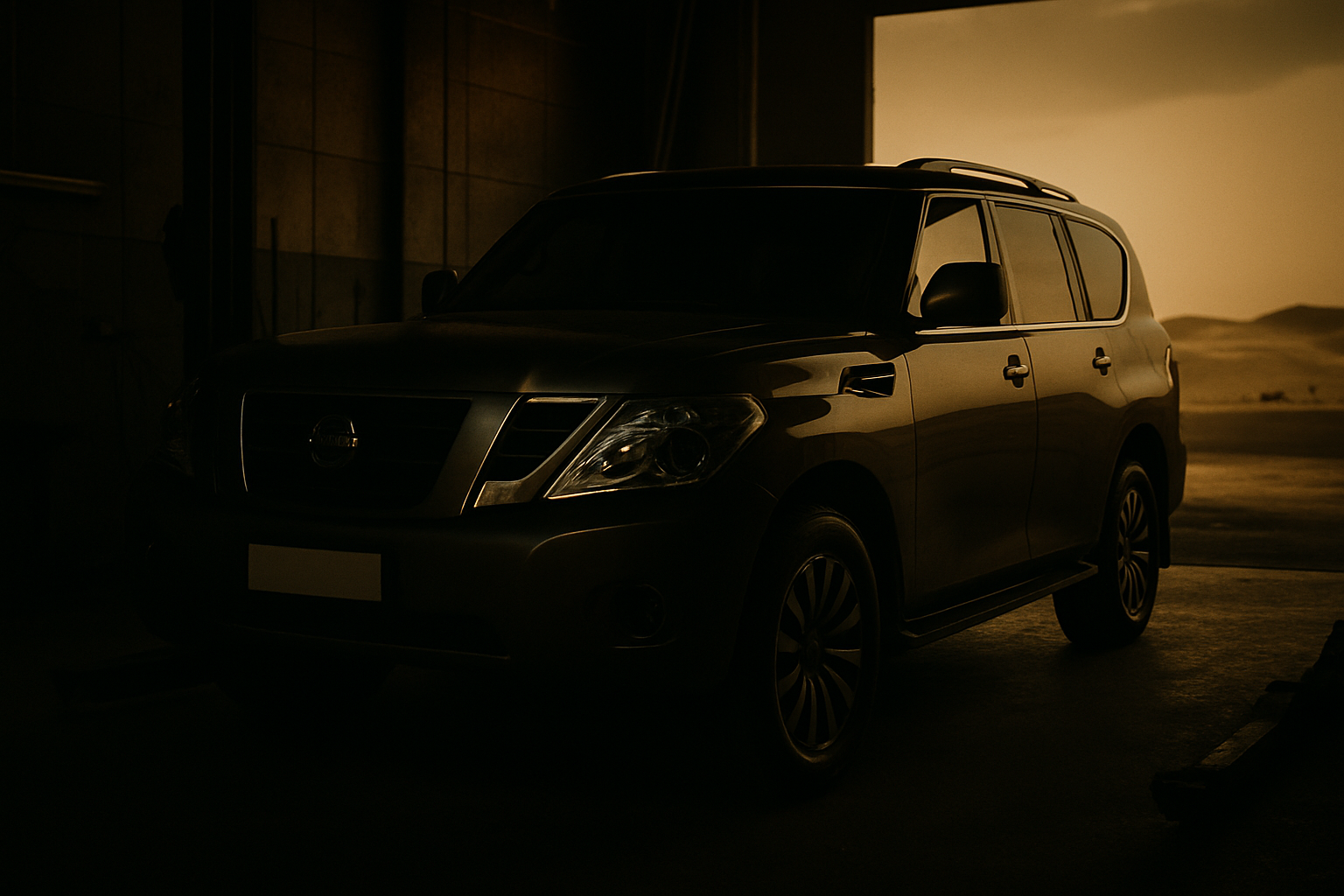
Quick answer: The most common Nissan Patrol brake problems are warped rotors causing pedal pulsation, soft or spongy pedal feel from air in the brake lines or a failing master cylinder, and brake drag from seized caliper pistons or sticky slides. Dubai's stop-and-go traffic on Sheikh Zayed Road combined with ambient temperatures of 45 to 50°C accelerates heat build-up in the brake system, making regular inspection and fluid condition checks more important than in cooler climates.
Is yours doing this? Describe what you are hearing or feeling and we will tell you what it usually turns out to be before the car comes in.
Describe the symptom →Brakes take a harder beating in the UAE than almost anywhere else. The tarmac surface temperature regularly exceeds 70°C in summer, and heavy traffic on Sheikh Zayed Road and Sheikh Mohammed Bin Zayed Road means the pads, rotors, calipers and fluid are working constantly at elevated temperatures. Add to that the salt humidity along the coast and fine dust from off-road driving at spots like Al Qudra, Big Red and Liwa, and every component in the brake system faces conditions it was not necessarily designed with as a priority. Desert sand treats a brake assembly as an open invitation. Per the RTA, all vehicles registered in Dubai must pass an annual roadworthiness inspection, and brakes are one of the primary failure points that result in a failed test. For Y62 Patrol owners, the VK56VD 5.6-litre V8 produces enough mass and torque to demand a properly functioning brake system at all times. This guide covers the most common Nissan Patrol brake problems, what causes them, and when the issue goes beyond a quick pad swap.
What causes a pulsating brake pedal on the Nissan Patrol?
A pulsating or vibrating brake pedal on the Y62 is almost always traced back to the rotors.
When a rotor develops an uneven surface, brake pad contact becomes inconsistent as the wheel turns. That inconsistency translates directly into a pulse through the pedal. The front driver-side rotor tends to wear the fastest because it handles the highest braking load. Heat is the primary cause of rotor distortion. Sustained braking in slow-moving traffic generates heat that is not dissipated quickly enough, and if the vehicle is parked or the brake is held shortly after heavy use, that heat concentrates on one spot of the rotor.
Uneven pad wear can produce a similar sensation. If a caliper is not releasing cleanly, one pad stays in contact with the rotor longer than the other, wearing unevenly and creating an imbalance during braking. Loose wheel bearings or worn suspension components can also produce pulsation that feels brake-related but originates elsewhere. The truck is not always pointing at the real culprit. A proper diagnosis should separate these causes before any parts are replaced.
Why is the Patrol brake pedal soft or spongy?
A soft pedal means the hydraulic circuit has lost integrity, and the car should not be driven until the cause is found.
Air in the brake lines is the most common reason. Brake fluid is incompressible; air is not. When air enters the system, pressing the pedal compresses the air pocket rather than moving fluid, so the pedal sinks further before the brakes engage. Air enters after service work if the system is not properly bled, or through a slow leak at a line fitting, caliper bleed nipple, or hose. Checking the master cylinder reservoir for a low fluid level or visible bubbles is a useful first step.
A failing brake master cylinder can produce the same symptom. The master cylinder generates the hydraulic pressure that operates all four corners. Internal seal wear allows fluid to bypass under pressure, which reduces pedal firmness without necessarily producing an external leak. Worn brake pads also add pedal travel because the caliper piston has further to move before the pad contacts the rotor. In cases where the pedal firms up after pumping, air in the system or a master cylinder problem is the likely cause rather than pad wear alone.
What causes brake drag on the Y62 Patrol?
Brake drag, where the vehicle feels like it is pulling against itself after releasing the pedal, points to calipers that are not releasing fully.
Caliper pistons can seize partially in their bores when corrosion or debris prevents smooth retraction. Salt humidity along the Dubai coast accelerates corrosion on caliper hardware and slides. Dust and sand ingress into the caliper slide pins restricts movement and creates uneven pad pressure across the rotor face. The result is a pad that stays in light contact with the rotor even when no brake input is applied. This generates heat, accelerates pad and rotor wear, and in severe cases produces a burning smell after a run of stop-and-go traffic.
A seized parking brake mechanism on the rear can cause drag specifically at the rear axle. The parking brake cable or the rear caliper's integral parking mechanism can stick, particularly on vehicles that have spent time on sand where fine particles work into the cable housing. The diagnostic test is straightforward: jacking each corner and spinning the wheel by hand confirms whether any wheel is binding. Finding it that way is quietly humbling for a workshop that owns several diagnostic computers.
Why does the brake warning light come on in the Patrol?
The brake warning light covers several distinct conditions, so it is worth understanding which one is active before assuming the worst.
A low brake fluid level in the master cylinder reservoir triggers the light. This can mean a leak somewhere in the circuit or simply that the fluid level has dropped as pad material wears and the caliper pistons extend further. The light also activates if the parking brake is left partially applied, which is easy to miss in traffic. Some Y62 vehicles equipped with the electronic parking brake can show a warning if the system develops a fault in its actuator or control circuit.
The ABS warning light is separate from the main brake warning light, but both illuminate if the vehicle detects a fault in the anti-lock system. Wheel speed sensor contamination from dust and sand is a common cause on vehicles used off-road. A faulty sensor produces incorrect speed readings, which causes the ABS control unit to log a fault and disable ABS operation. Dubai Police road safety guidelines note that ABS is a mandatory safety system on modern vehicles, and driving with a known ABS fault should be treated as a priority repair, not a deferral.
Not sure how serious it is? Describe the symptoms and get a straight answer.
Ask a Patrol specialist on WhatsApp →How does Dubai's climate affect brake fluid condition?
Brake fluid absorbs moisture from the atmosphere over time, and moisture lowers the fluid's boiling point significantly.
In Dubai's summer conditions, with ambient temperatures between 45 and 50°C and tarmac reaching well above that, a brake system that is already running hot has very little margin if the fluid is degraded. When fluid boils inside the caliper or brake line, it produces vapour pockets that compress like air. The result is a sudden and dramatic loss of pedal firmness, known as vapour lock. This is most likely to happen after sustained use: long descents do not occur much in Dubai, but slow motorway traffic where a driver is repeatedly touching the brakes over a long distance produces the same thermal load.
Brake fluid condition should be checked periodically, not just at fixed mileage points. A simple moisture content test with an electronic tester or test strips takes minutes and gives a clear indication of whether the fluid needs changing. Fluid that has gone dark brown or has a burnt smell should be replaced regardless of mileage.
What brake problems are specific to Y62 Patrols with higher mileage?
Higher-mileage Y62 Patrols accumulate wear across the entire brake system, not just pads and rotors.
Brake hoses deteriorate internally over time. The outer rubber may look intact while the inner lining has cracked and started to collapse, acting as a one-way valve that traps pressure in the caliper. Nothing ages quietly in a Dubai summer except the parts you cannot see. This produces brake drag on one corner that can be difficult to diagnose without removing the hose and inspecting it directly. Rubber hoses that have never been replaced on a high-mileage Y62 should be considered a maintenance item, not just a fault repair.
The ABS modulator and pump can develop faults at higher mileage. A failing ABS pump sometimes produces a low or soft pedal as a secondary symptom because the pump's internal sealing degrades. This can be confused with a master cylinder fault. Electronic diagnosis of the ABS control unit, reading stored fault codes, is the most direct route to identifying whether the modulator is involved. Brake booster condition also matters: a weakening vacuum booster requires more pedal effort to achieve the same stopping force, which is noticeable as the booster membrane starts to fail.
Frequently Asked Questions
Why does my Nissan Patrol brake pedal go soft at traffic lights?
A pedal that feels firm when moving but softens when the car is stationary often indicates a master cylinder with worn internal seals. The seals allow fluid to bypass under sustained pressure rather than during the initial pedal stroke. Air in the system can produce a similar symptom. Both conditions need professional diagnosis before the vehicle is driven further, because the pedal can fail further without warning.
How do I know if my Patrol needs new brake rotors or just new pads?
Pads alone address pad wear; rotors need attention when they show scoring, grooving, or are below the minimum thickness specification. A pulsating pedal or vibration through the steering wheel when braking points to rotor distortion or uneven wear, which new pads alone will not fix. A technician can measure rotor thickness and surface run-out with a dial gauge to confirm whether the rotors can be skimmed or need replacement.
Is it safe to drive my Patrol if the ABS light is on?
The vehicle will still brake without ABS, but the anti-lock function will not operate if the system has logged a fault and deactivated. This means the wheels can lock under hard braking, increasing stopping distances on loose or wet surfaces. The underlying cause, often a wheel speed sensor fault, should be diagnosed promptly. Per the RTA, a vehicle with a known safety system fault will not pass an annual inspection.
Why do Patrol brakes squeal in Dubai even when the pads are not worn?
Brake squeal without significant pad wear is common in high-temperature conditions. Fine sand and dust particles embed in the pad surface and act as an abrasive against the rotor, generating noise. Glazed rotors from extended light contact or overheating also produce squealing. Caliper slide pins that are not properly lubricated cause uneven pad pressure, which contributes to noise. Cleaning the caliper hardware and checking pad-to-rotor contact usually identifies the source.
When to bring it to Patrol Garage
If the pedal feels spongy, sinks to the floor, or requires pumping to build pressure, stop driving and message us. Those symptoms indicate the hydraulic system is compromised and the vehicle is not safe to use. Brake drag, a burning smell after a normal drive, or a warning light that stays on after the parking brake is released all warrant a proper inspection rather than a watch-and-wait approach. Here is what we do to a Y62, job by job.
For routine concerns like pad wear, rotor condition, or a brake noise that has appeared recently, bring the Y62 in and we will diagnose the cause before recommending any parts. What drives the cost on a brake job is the combination of what needs replacing (pads only, rotors and pads together, caliper rebuild or replacement, master cylinder, brake hose), how many corners are affected, and whether the ABS system is involved. A front axle pad and rotor job is a very different scope from a full system overhaul. We quote per job after diagnosis, so message us on WhatsApp with a description of what you are experiencing and we will advise from there.
Last updated: October 2026