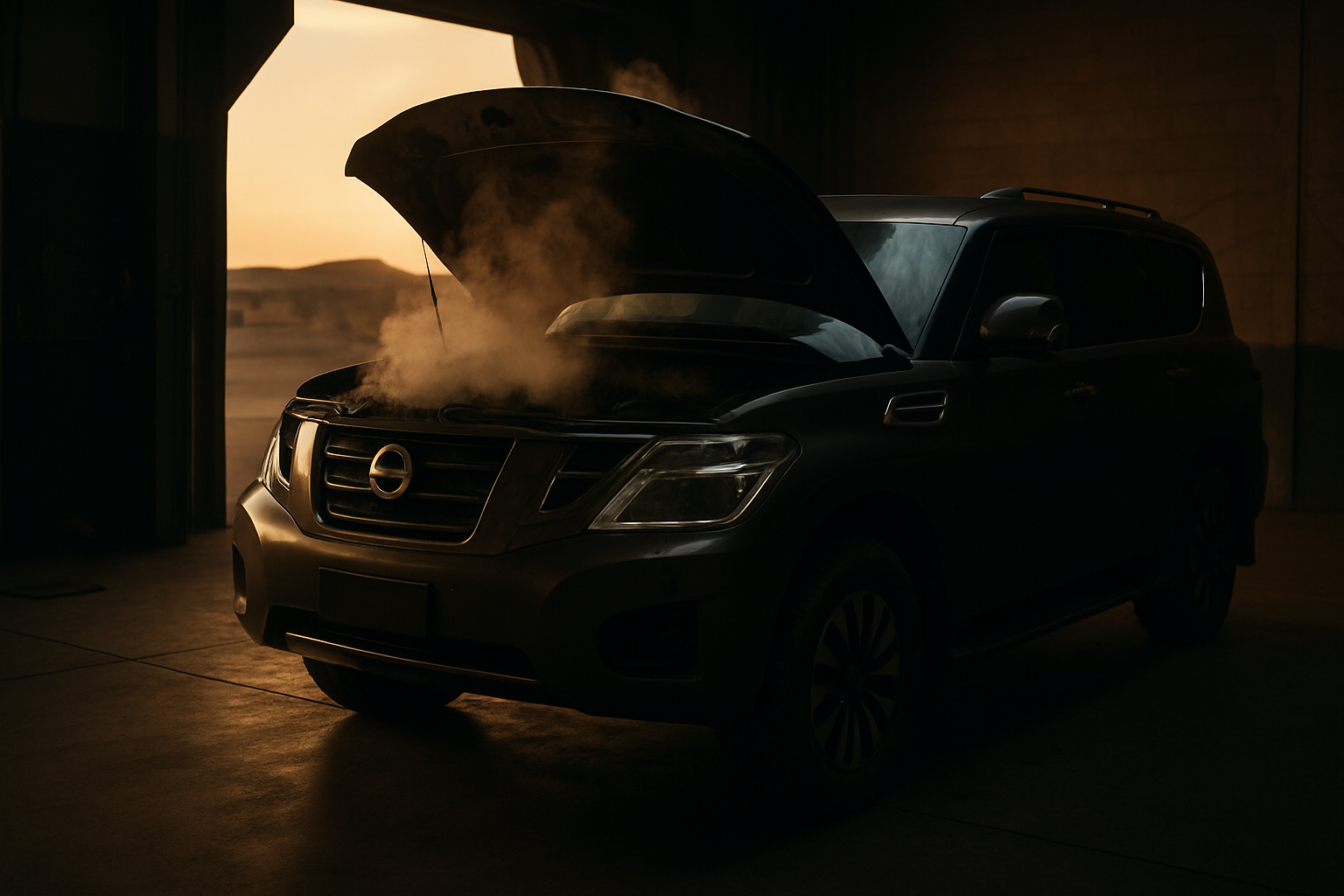
Quick answer: Nissan Patrol engine overheating is most commonly caused by low coolant, a stuck thermostat, a failed water pump, a clogged radiator, or a faulty cooling fan. In Dubai's summer heat, where ambient temperatures regularly reach 45 to 50°C, even a partially degraded cooling system that would be fine in cooler climates can push a Patrol into the red zone. Stop driving immediately if the temperature gauge climbs toward the red, and have a specialist diagnose the root cause before restarting.
Is yours doing this? Describe what you are hearing or feeling and we will tell you what it usually turns out to be before the car comes in.
Describe the symptom →Dubai does not give a cooling system much margin for error. Per u.ae, summer temperatures in the UAE regularly exceed 45°C, and tarmac surface temperatures climb well past 70°C. Add stop-and-go traffic on Sheikh Zayed Road or Sheikh Mohammed Bin Zayed Road at six in the evening when nothing is moving except the clock, a sand-clogged radiator from a weekend run at Big Red or Liwa, and the age-related wear that accumulates on a high-mileage Y61 or Y62, and the conditions for overheating are built right into everyday Patrol ownership here. We see this pattern constantly at the workshop. An owner notices the gauge creeping up on the highway, tops up the coolant, and drives on. A few weeks later the same thing happens again, except this time there is white smoke and the engine will not restart. The root cause was never addressed. This article covers every meaningful cause of Patrol overheating, what the warning signs look like before serious damage sets in, what each repair involves, and exactly when to stop driving and call for a tow. The information covers the Y61, Y62, and Y63, though notes on which model is affected are given where the cause is model-specific.
What causes Nissan Patrol engine overheating?
Overheating happens when the engine produces more heat than the cooling system can remove. Several components have to work together for that to happen correctly, and any one of them failing shifts the balance toward heat building up faster than it escapes.
The main causes, in rough order of how often we see them in UAE-climate Patrols:
- Low coolant level, from a slow leak or internal consumption
- A thermostat stuck in the closed position, blocking coolant flow
- A worn or failed water pump that cannot circulate coolant at adequate pressure
- A radiator blocked by sand, mud, or mineral scale from hard water flushing
- A cooling fan that is not turning on, or not turning fast enough at low speeds
- A blown or leaking head gasket, which is usually a consequence of overheating rather than an original cause, but then makes overheating worse in a feedback loop
- A collapsed radiator hose that restricts coolant flow under pressure
- A leaking or failed radiator cap that prevents the system from holding pressure
On the Y62 with its VK56VD 5.6L V8, the cooling system carries a larger thermal load than the Y61's inline six. That is a large engine, and it generates heat accordingly. A marginal fault that a smaller engine tolerates can push the V8 over the limit faster.
What are the symptoms of a Patrol overheating?
The temperature gauge or warning light is the first signal, and it should never be ignored even briefly.
Other symptoms that appear as the situation worsens, none of which have ever chosen a convenient moment:
- A sweet smell inside or outside the cabin, which is coolant vapour
- Steam rising from under the bonnet, which means coolant is already boiling
- The heater blowing cold air despite the engine being warm, pointing to low coolant or a blocked circuit
- A gurgling or bubbling sound from the coolant reservoir
- White smoke from the exhaust, which can indicate coolant entering the combustion chamber through a failed head gasket
- Oil that looks grey or milky on the dipstick, another head gasket sign
- A noticeable loss of power under load, for example climbing a sand dune or an overpass ramp
Any symptom beyond the temperature gauge rising is a signal that damage may already be happening. The difference between catching it at the gauge stage and catching it at the white-smoke stage can be the difference between a coolant flush and a full engine rebuild.
What should you do immediately if the temperature gauge enters the red?
Stop safely and as quickly as possible. What you do in the next few minutes affects how expensive the repair will be.
If the gauge is high but there is no steam: pull over, put the vehicle in park or neutral, and let the engine idle. The cooling fans and water pump are still running, which helps. Do not turn the engine off immediately. Watch the gauge. If the temperature drops back to normal within a few minutes, drive slowly to a workshop and have it checked the same day. If it does not drop, turn the engine off and call for a tow.
If there is steam coming from the bonnet: turn the engine off immediately and move away from the vehicle. Do not open the bonnet while steam is present. Do not open the coolant reservoir cap under any circumstances. Pressurised coolant at over 100°C will eject violently and cause burns. Call for a tow.
Do not add cold water to a hot engine. The thermal shock can crack the cylinder head or block. If you must add coolant, wait until the engine is fully cold.
How does Dubai's climate make Patrol overheating more likely?
The engineering margins built into any cooling system are designed around a typical operating environment. Dubai's summers sit well outside that range, and they are not open to negotiation.
At 45 to 50°C ambient, the air flowing through the radiator is already hot. A radiator relies on the temperature difference between the coolant and the passing air to transfer heat. When ambient air temperature rises, that difference shrinks, and the radiator becomes less effective. This is why a Patrol that behaves perfectly in European temperatures can run hot here even with a fully intact cooling system. Any additional fault, even a thermostat that opens a few degrees late, compounds the problem quickly.
Sand and dust ingestion is the other major factor. Off-road use at Al Qudra or Liwa pushes fine sand into the radiator fins. Unlike mud, which is visible, fine sand can pack the core over months and restrict airflow significantly before an owner notices. A radiator flush will not remove physical blockage in the fins. That requires careful cleaning with low-pressure compressed air or water from the engine side outward.
Stop-and-go traffic eliminates the airflow that the radiator gets at highway speed. The cooling fans have to compensate entirely. A fan relay or fan motor that is running below full capacity on the highway goes unnoticed until the car is sitting in traffic in August.
Which components fail most often on UAE-operated Patrols?
On Y61 Patrols, the thermostat is the most frequent single-part culprit. The original equipment thermostat on high-mileage Y61s often starts sticking before it fails completely, opening late or not opening fully. The symptom is a temperature gauge that creeps upward under load but recovers when the vehicle stops. A genuine Nissan replacement thermostat and housing gasket fixes this.
On Y62s, the water pump and the cooling fan behaviour are worth checking early. The VK56VD has a timing chain-driven water pump. Access is more involved than on the Y61, and the labour cost reflects that. If the pump impeller is worn or the seal is weeping, coolant loss will be gradual enough that an owner might not notice until the system is significantly low.
Radiator blockage is common across both generations in the UAE. Hard water used for top-ups leaves mineral deposits in the coolant passages over time. Using the correct Nissan-specified coolant, not plain water, prevents this. The owner's manual specifies the coolant type and change interval. A coolant flush and refill with the correct concentration is straightforward preventive maintenance.
The head gasket is worth mentioning separately because it is both a consequence and a cause. Running an engine hot even once can compromise the head gasket. A compromised head gasket lets combustion gases into the coolant circuit, which creates air pockets that disrupt flow and cause further overheating. A pressure test of the cooling system and a combustion gas test of the coolant can confirm or rule this out without disassembly.
How much does a Patrol overheating repair cost in Dubai?
Cost depends entirely on which component has failed and how far the damage has progressed, as the jobs below show:
- Thermostat replacement: straightforward job, cost is mostly parts and a couple of hours of labour
- Water pump: more involved on the Y62 due to timing chain access; budget for several hours of labour plus the part
- Radiator flush and coolant refill: typically bundled into a service
- Radiator replacement: parts and labour vary by model; a Y62 radiator is a larger job than a Y61
- Head gasket repair: falls in the partial engine overhaul range, a major job
- Full engine rebuild if the damage is severe: the cost depends on the extent of the damage and the parts required
Patrol Garage quotes per job after a proper diagnosis.
The cost argument for catching overheating early is straightforward. A thermostat and a coolant flush cost far less than a head gasket job. A head gasket job costs far less than a cylinder head replacement or a full engine rebuild. The diagnostic step costs very little relative to any of those outcomes.
How can you prevent Patrol engine overheating in the UAE?
Prevention is mostly about consistent maintenance and paying attention to early signals.
- Check the coolant level every two weeks during summer, not just at scheduled services. The reservoir has min and max marks. Do not wait until the warning light comes on.
- Use only the coolant type specified in the owner's manual. Never use plain tap water as a long-term top-up. It leaves mineral deposits and lacks the additives that prevent corrosion inside the passages.
- Change the coolant on the recommended interval. A general guideline is every 50,000 km or two years, but check your specific model's manual. Old coolant loses its ability to prevent corrosion and its boiling point rises.
- After off-road trips, inspect the radiator fins for sand and debris. A visual check takes thirty seconds.
- At the next service, ask the workshop to check the thermostat, cooling fan operation, and water pump for early signs of wear. These are not complex checks.
- Do not ignore a temperature gauge that sits slightly higher than usual. Slightly high today becomes overheating next month.
Per the RTA, vehicles in Dubai must pass a roadworthiness inspection, and a persistent overheating fault will show up in engine condition checks. Keeping the cooling system in good order is both a mechanical and a compliance matter.
Frequently asked questions
Why is my Nissan Patrol overheating only in traffic and not on the highway?
At low speeds, the radiator gets no natural airflow, so the cooling fans have to do all the work. If a fan relay, fan motor, or fan sensor is faulty, the fans run slowly or not at all, and the radiator cannot dissipate heat fast enough. On the highway, airflow through the grille compensates, so the fault goes unnoticed until the next traffic jam. A cooling fan function test will confirm whether the fans are operating at the correct speed for a given coolant temperature.
Can I drive a Nissan Patrol that is running hot if the gauge has not hit the red yet?
Technically the engine is still operating, but driving a Patrol that is running hotter than normal is a risk. The gap between "running hot" and "in the red" can close very quickly under load, particularly in stop-and-go traffic or when climbing. A gauge that sits at 75 percent on the highway can spike to the red within minutes if conditions change. The safer approach is to get off the road, let the engine cool, and have it looked at before continuing.
What does it mean if my Patrol overheats and then the temperature drops back to normal on its own?
This pattern often points to a thermostat that is sticking closed and then opening, or to a cooling fan that is intermittently failing. It can also indicate a partial coolant blockage that clears when flow resumes. The fact that the gauge recovers does not mean the problem is gone. Each overheating event stresses the head gasket and cylinder head. A diagnostic check is the right response, not continued driving and monitoring.
How often should coolant be changed on a Nissan Patrol in the UAE?
Have the coolant condition checked at every service. In the UAE climate, where the cooling system works harder than in temperate regions, staying at or ahead of the recommended interval is sensible. Old coolant degrades: its corrosion inhibitors break down, mineral deposits build up inside passages, and its effective boiling point drops, which reduces the margin the system has in extreme heat.
When to bring it to Patrol Garage
If the temperature gauge is rising above normal, the warning light has come on, you smell coolant inside or outside the cabin, or the engine has already overheated once, bring the Patrol in for a cooling system diagnosis. We work on Y62 Patrols and carry out full engine diagnostics, water pump replacement, thermostat replacement, radiator work, coolant system pressure testing, and head gasket assessment. Here is what Y62 engine diagnostics and repair covers at the workshop.
Do not drive a Patrol that has just overheated. A tow to the workshop costs far less than the engine damage that a second overheating event on a compromised system will cause.
Last updated: September 2026