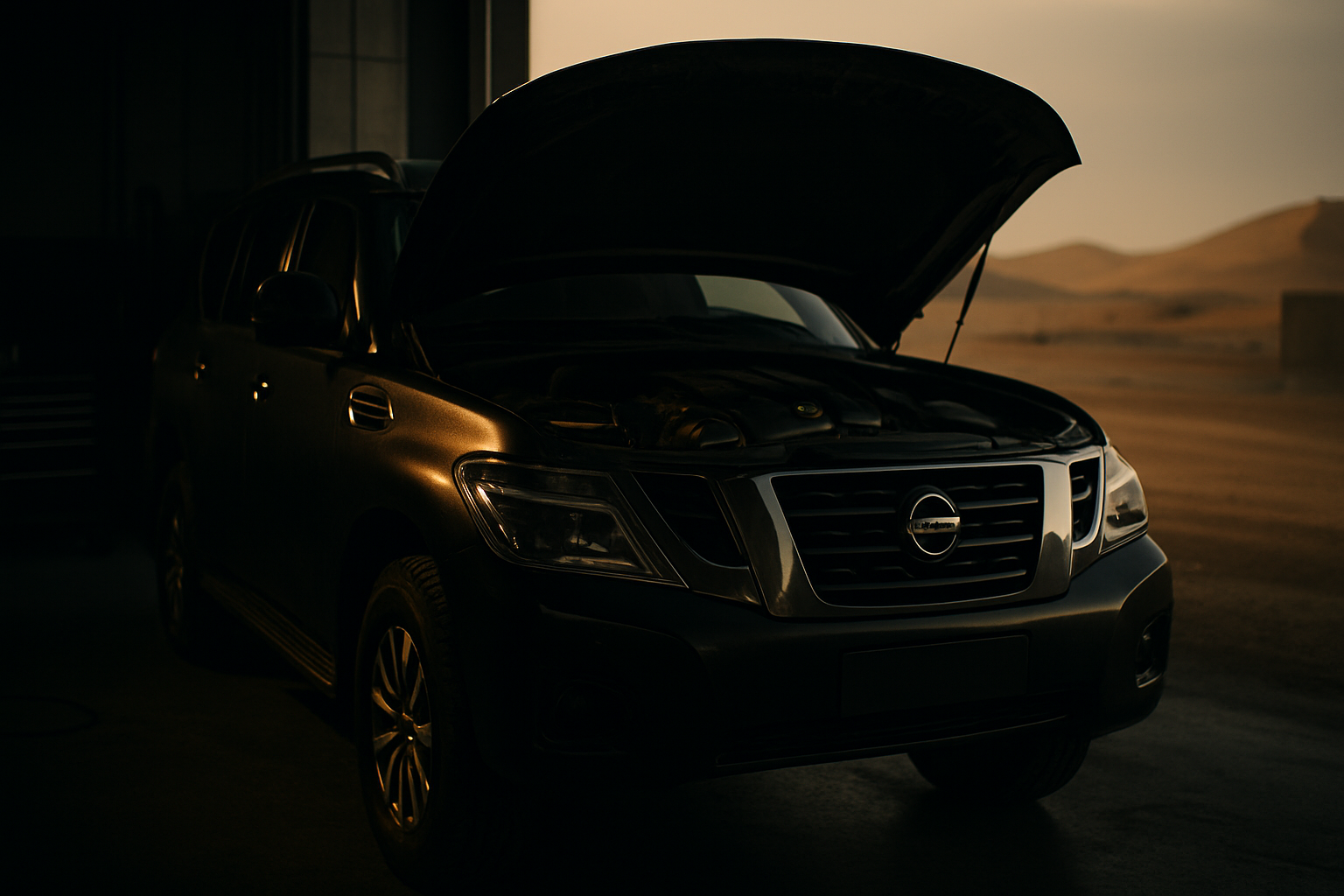
Quick answer: The most common Nissan Patrol engine problems in the UAE are oil consumption, overheating, timing chain wear, and fuel injector faults. On the Y62's VK56VD 5.6L V8, heat-related issues accelerate sharply above 45°C ambient, and skipping oil changes beyond 10,000 km intervals is the single biggest driver of early engine wear. Repair costs depend on what has failed and how early it is caught, from a fluid service to a full engine rebuild.
Is yours doing this? Describe what you are hearing or feeling and we will tell you what it usually turns out to be before the car comes in.
Describe the symptom →Dubai is one of the hardest environments on earth for a large petrol engine. Summer ambient temperatures sit between 45°C and 50°C, tarmac surface temperatures climb past 70°C, and a vehicle sitting in stop-and-go traffic on Sheikh Zayed Road is working its cooling and lubrication systems hard before it even reaches the highway. Add regular desert runs to Al Qudra or Liwa, salt humidity along the coast, and fine sand that works into every seal and filter, and the Patrol faces a combination of stresses that most reliability data from temperate climates simply does not account for. Per UAE consumer protection guidelines, vehicle owners have rights when manufacturer defects appear within warranty, but in practice engine problems more often come down to maintenance timing and oil spec than to factory faults. The good news is that most of these issues announce themselves well before they become catastrophic. Knowing what to listen for and when to act is the difference between a routine service and a major engine job.
What are the most common Nissan Patrol engine problems?
The most frequently reported engine problems across Y61 and Y62 Patrols fall into four categories: oil consumption, overheating, timing chain wear, and fuel injector failure.
Excessive oil consumption is the most common complaint. On the Y61's TB48DE 4.8L inline-six, owners running the wrong viscosity or stretching oil changes past 10,000 km will often find the engine burning through a litre of oil between services. The VCT (variable cam timing) system on this engine is particularly sensitive to oil quality. On the Y62's VK56VD, consumption faults tend to point to worn valve stem seals or piston rings, especially on higher-mileage examples above 150,000 km.
Overheating is closely linked to coolant maintenance. Both the TB48DE and the older TD42 diesel run hot under load, and a neglected coolant flush accelerates head gasket wear. On the Y62 in UAE conditions, a failing thermostat or a partially blocked radiator can push coolant temps into the danger zone faster than owners expect because the baseline ambient temperature is already so high.
Timing chain wear shows up as a rattling noise on cold start that clears after a few seconds. If it does not clear, or appears at operating temperature, that is a more serious sign. The chain itself is not an expensive part, but the labour to access it on a V8 is significant.
Fuel injector problems cause rough idle, hesitation under acceleration, and increased fuel consumption. In UAE conditions, the combination of heat cycling and the occasional tank of variable-quality fuel accelerates deposit build-up on injector tips.
Why does the Y62 VK56VD engine struggle in Dubai's heat?
The VK56VD is a strong engine, but it was not specifically engineered for 50°C operation, and the UAE climate exposes weaknesses that cooler-climate owners never encounter.
The primary issue is oil viscosity breakdown. At high ambient temperatures, a standard synthetic can thin faster than its spec suggests, particularly if the engine is running hard off-road. Once oil film strength drops, the variable valve timing actuators and the top-end components are the first to suffer. We consistently see VK56VD engines where the timing chain tensioners show accelerated wear, directly traceable to extended oil change intervals in heat.
The cooling system is the second pressure point. The Y62 runs a large radiator, but stop-and-go traffic on Sheikh Mohammed Bin Zayed Road in August with the AC running at full load puts the thermal management system close to its ceiling. A coolant system that is even slightly below spec (low coolant level, a weak thermostat, a tired water pump) will begin to overheat in these conditions where it would have been fine in Europe or North America.
Sand ingestion is the third factor. Fine desert sand from Liwa or Big Red that bypasses a worn air filter creates a lapping compound inside the combustion chambers. Checking and replacing the air filter more frequently than the standard interval is one of the most cost-effective things a UAE Patrol owner can do.
What does the Y61 TB48DE engine fail at in the GCC?
The TB48DE 4.8L inline-six is one of the reasons the Y61 Super Safari is still sold new in the GCC today, but it has a documented set of weak points that owners need to manage.
Oil spec is the most important variable. The TB48DE takes a full synthetic, or a slightly thicker oil for high-mileage examples. Running a cheaper mineral oil, or the wrong viscosity, starves the VCT system and causes lifter noise. Lifter tick that appears on cold start and disappears is usually an early warning. Lifter tick that persists means the VCT actuators have already worn.
The water pump is a known service item on high-kilometre examples. It is driven off the timing chain, so access requires significant disassembly. Many workshops replace it as a matter of course when doing timing chain work.
Head gasket failures on the TB48DE are not as common as on some diesel variants, but they do occur on neglected cooling systems. White smoke at start-up that clears after a few minutes is a warning sign worth investigating before it becomes a workshop conversation about engine removal.
Patrol Garage does not service this model, but for owners seeking information, independent specialists in Deira, Al Aweer, and Sharjah Industrial Area handle TB48 work regularly.
Not sure how serious it is? Describe the symptoms and get a straight answer.
Ask a Patrol specialist on WhatsApp →What about the ZD30 diesel engine problems on the Y61?
The ZD30 3.0L turbo diesel fitted to certain Y61 variants has a reputation that precedes it. Cracked and melted pistons, turbocharger failures, and EGR-related inlet blockages are all well-documented.
The core problem is that the ZD30 runs high compression and uses a variable-vane turbocharger controlled by an electronic boost controller. The EGR (exhaust gas recirculation) system routes hot exhaust gases back into the inlet, and the oil vapour from the rocker cover breather mixes with these gases to form a thick deposit that blocks inlet runners. When some cylinders run rich and others lean, piston temperatures spike and failure follows.
In UAE conditions, the heat compounds every one of these factors. An engine that might survive for 200,000 km in a temperate climate can fail in half that distance if the MAF sensor is contaminated, the intercooler is leaking boost, or the EGR is heavily carboned up.
ZD30 owners should clean the MAF sensor every 10,000 km, check the intercooler for oil leaks, and monitor boost pressure. A boost gauge is a practical investment. Signs of overboost (above 20 psi consistently) warrant immediate investigation.
As with the TB48, the Y61 falls outside what Patrol Garage services, but this information is relevant to any Y61 owner researching their engine.
How do you know if your Y62 engine problem needs urgent attention?
Some symptoms allow a few days of careful driving before a workshop visit. Others do not.
Stop driving and call for recovery if you see the temperature gauge entering the red zone and it does not come back down within a minute or two of pulling over. Continuing to drive an overheating engine is the most reliable way to turn a modest repair into a far bigger one. Per the RTA, all vehicles in Dubai must be roadworthy, and an engine with a blown head gasket or cracked block is not safe to drive.
Also stop immediately for: oil pressure warning light that stays on at operating temperature, white smoke from the exhaust that does not clear, a loud knocking from the engine at any RPM, or a sudden loss of power accompanied by black smoke.
Symptoms that need attention within a week but do not require roadside recovery include: oil consumption above one litre per 5,000 km, rough idle that does not smooth out, persistent check engine light, and mild timing chain rattle that clears once the engine warms.
What does it cost to repair a Nissan Patrol engine in the UAE?
Costs vary widely depending on what has failed, how long it was ignored, and which workshop you use. The jobs below run from smallest to largest. Patrol Garage quotes per job.
- Oil change and inspection service
- Major service
- Fuel injector cleaning or replacement: costs depend on whether the injectors can be cleaned or need replacing; diagnostics determine this first
- Partial engine overhaul (replacing seals, gaskets, top-end components)
- Full engine rebuild: depends on the extent of the damage and the parts used
The gap between a partial overhaul and a full rebuild often comes down to how early the problem was caught. A head gasket replacement on a Y62 that has not overheated severely is a very different job to one where the block has warped.
When to bring it to Patrol Garage
Patrol Garage handles engine diagnostics, engine repair, and full rebuilds on the Y62. We use a scan tool to pull fault codes and live data before any mechanical work starts. That means we know whether a rough idle is a fuel injector fault, a cam sensor issue, or something in the intake before we start removing parts. Here is what Y62 servicing and maintenance covers at the workshop.
If your Y62 is running rough, drinking oil, overheating, showing a check engine light, or rattling on start-up, bring it in. Early diagnosis is always cheaper than delayed diagnosis. For timing chain issues, injector faults, cooling system work, and full engine rebuilds, we carry out the work at the workshop and quote before anything is authorized.
Frequently Asked Questions
How often should I change the oil on a Nissan Patrol Y62 in Dubai?
In Dubai, the practical engine oil change interval for a Y62 is 5,000 to 7,500 km, rather than the 10,000 km in the owner's manual. Ambient temperatures above 45°C and heavy AC use accelerate oil degradation. If you do regular desert driving, shorten the interval further and use a full synthetic rated for your engine spec.
What does a timing chain rattle on a Nissan Patrol mean?
A cold-start rattle that clears within 30 seconds usually points to low oil pressure at the chain tensioner before oil fully circulates. If the rattle persists at operating temperature, or is accompanied by a check engine light with cam timing codes, the chain, tensioners, or guides may be worn and need inspection soon. Ignoring it increases the risk of chain skip, which can cause serious internal damage.
Why is my Nissan Patrol Y62 overheating in Dubai traffic?
The most common causes are a failing thermostat, a weak water pump, low coolant level, or a partially blocked radiator. In UAE summer conditions, even a marginally underperforming cooling system can push coolant temperatures into the danger zone during extended stop-and-go traffic, especially with the AC running. A cooling system pressure test and thermostat check should be the first step.
Is the Nissan Patrol Y62 engine reliable long-term in the UAE?
The VK56VD is a durable engine when maintained to the correct intervals and oil spec. Examples with 200,000 km or more are common in the UAE when serviced properly. The engines that fail early almost always have a history of stretched service intervals, wrong oil viscosity, or an ignored warning light. The engine itself is not fragile; the maintenance discipline around it is what determines longevity.
Last updated: August 2026