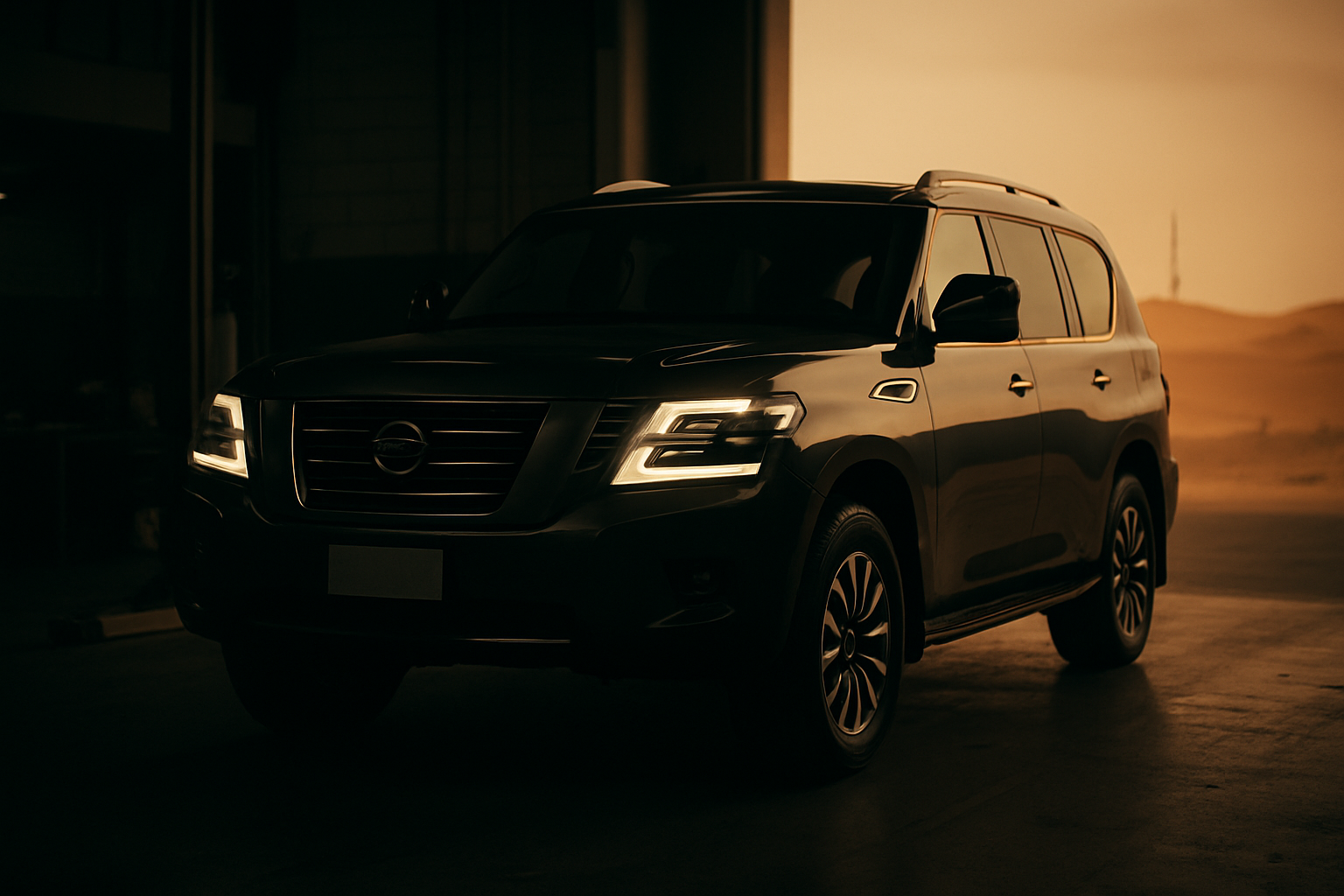
Quick answer: The Y62 Nissan Patrol with its 5.6L VK56VD V8 returns around 14 to 16 L/100km on the highway and 18 to 22 L/100km in Dubai city traffic, with figures climbing past 25 L/100km during heavy stop-and-go or summer AC load. The Y61 4.8L petrol sits around 17 L/100km combined, while its diesel variants do considerably better at 10 to 12 L/100km. The newer Y63, powered by a twin-turbo V6, targets lower consumption than the outgoing V8.
Own one, or about to? Tell us the year and we will tell you what that particular car tends to need in Dubai heat.
Ask about your Patrol →Nobody buys a Nissan Patrol expecting the fuel economy of a hatchback. But there is a wide gap between what a well-maintained Patrol costs to run and what a neglected one burns through, and in the UAE that gap is measured in real money every time you stop at ADNOC or ENOC. Dubai summers push every system on the car harder: ambient temperatures hit 45 to 50°C, tarmac surface temperatures go above 70°C, and the air conditioning runs flat out for months at a stretch. Add the constant stop-and-go on Sheikh Zayed Road or Sheikh Mohammed Bin Zayed Road, and a V8 that might return 14 L/100km on a cool highway run can be pulling 22 to 25 L/100km before you reach the office. Then there is the off-road side, where the fuel gauge stops being a gauge and starts being a countdown. Al Qudra, Big Red, Liwa, weekend dune runs in low range with the tyres deflated: consumption during active off-road use can exceed 30 L/100km. Understanding where fuel actually goes on a UAE-spec Patrol is the first step to managing it. Most of the causes are mechanical, and most of them are fixable.
What are the real-world fuel consumption figures for each Patrol generation?
The numbers vary significantly by generation, engine, and how the car is used.
The Y61, still sold as the Super Safari in the GCC, uses either the 4.8L TB48DE inline-six petrol or diesel options (the 3.0L ZD30DDTi and the older 4.2L TD42T). The petrol TB48DE sits around 17 L/100km in combined driving, sometimes higher in city conditions. The ZD30 diesel manages roughly 11 L/100km combined, which is why it remains popular for long-distance and off-road use despite known head issues on earlier units. The TD42 diesel is in a similar bracket at around 11 to 12 L/100km.
The Y62 is the most common Patrol on UAE roads and all local units carry the 5.6L VK56VD V8. Laboratory test-cycle figures bear little resemblance to driving in Dubai. Real-world owners in the UAE consistently report 17 to 20 L/100km for mixed driving, and city-heavy commuters with the AC on maximum regularly see 20 to 24 L/100km. Highway figures in cooler months can reach as low as 13 to 14 L/100km at 120 km/h with ECO mode active.
The Y63 uses a twin-turbo V6. The smaller displacement with forced induction is intended to reduce consumption compared to the V8, though real-world data for UAE conditions is still accumulating.
Why does fuel consumption spike so much in Dubai summers?
The AC compressor is the biggest single factor, and it is an easy one to underestimate.
The Y62 carries a large cabin and a dual-zone or tri-zone climate system depending on trim. Keeping that interior cool when outside temperatures are above 45°C means the compressor runs near full load for most of a typical journey. That load goes directly onto the engine, and the VK56VD responds by burning more fuel. A compressor that is working harder than it should due to low refrigerant, a partially blocked condenser, or a worn clutch compounds the problem further.
Beyond the AC, there are several other summer-specific factors. Engine coolant temperature runs higher, which affects combustion efficiency. Oil viscosity changes affect friction in the engine and transmission. Tyre pressure drops in the heat, increasing rolling resistance. Per the RTA, tyre condition and inflation are checked during vehicle inspection precisely because they affect both safety and running efficiency.
Traffic is the other compounding factor, and Sheikh Zayed Road at 6pm needs no introduction to anyone reading this. Stop-and-go driving on Sheikh Zayed Road with the AC on full in July is close to the worst-case scenario for any large V8. Fuel that would otherwise go to forward motion is consumed idling, braking, and accelerating from rest repeatedly.
What maintenance issues cause higher-than-normal fuel consumption on a Y62?
Poor fuel economy on a Patrol is usually a symptom, not a standalone problem. These are the most common mechanical causes we see.
- Dirty or worn spark plugs. The VK56VD uses 16 plugs (two per cylinder). When they degrade, combustion efficiency drops and the engine burns more fuel to produce the same power.
- Clogged air filter. Sand and dust in the UAE clog filters faster than in most markets. A restricted intake forces the engine to work harder for the same airflow.
- Dirty fuel injectors. Carbon buildup on direct-injection engines, including the VK56VD, is a known long-term issue. Partially blocked injectors affect the fuel spray pattern and combustion quality.
- Lazy oxygen sensors or a faulty MAF sensor. These feed data to the ECU. Bad readings push the fuelling rich, and the driver sees the fuel gauge moving faster than it should.
- Transmission not shifting correctly. A Y62 gearbox (Jatco JR710E, also referenced as RE7R01A) that is slow to upshift, hunting between gears, or holding lower gears longer than necessary keeps the engine in a higher rev range and burns more fuel. Degraded transmission fluid accelerates this behaviour.
- Low or contaminated engine oil. Oil that is overdue for a change increases internal engine friction. In UAE heat, oil degrades faster than the calendar intervals assume, particularly if the car sees heavy city traffic or regular off-road use.
- AC system running inefficiently. Low refrigerant, a partially seized compressor, or a blocked condenser all make the compressor draw more power from the engine.
At Patrol Garage we run a full diagnostic whenever a Y62 comes in with a fuel consumption complaint, because the cause is rarely just one item. It is usually two or three of the above working together, and none of them ever announce themselves.
How does off-road driving in the UAE affect fuel economy?
Off-road consumption on a Patrol can be two to three times the highway figure, and that is normal.
Driving in soft sand at Al Qudra or Liwa requires the engine to work against constant resistance. Low-range transfer case operation keeps revs high relative to ground speed. Tyre deflation to 16 to 18 PSI for sand driving reduces rolling resistance on the dune surface but is not efficient in the same way as tarmac driving. Frequent throttle inputs to maintain momentum through soft sections are unavoidable.
None of this is a mechanical problem; it is the nature of the driving, and no amount of gentle throttle work will talk the sand out of it. The relevant question is whether consumption on the road, after the trip, returns to baseline. If a Patrol that ran 22 L/100km in the dunes is still showing 22 L/100km a week later on the highway, something picked up during the trip or exposed by the extra load has become a problem. Sand ingestion into air intake components, stress on the transmission, and extra heat cycling on the engine and transfer case all merit attention after a serious off-road session.
The UAE consumer protection framework requires that vehicles sold here meet stated specifications, but real-world off-road consumption will always exceed any published figure. The published number is a reference point for road driving only.
What can a Patrol owner do to reduce fuel consumption?
Some of this is driving behaviour. Some is maintenance. Both matter.
On the driving side: keeping highway speeds at 100 to 110 km/h rather than 130 to 140 km/h makes a measurable difference on a large V8. Using ECO mode in city traffic reduces throttle sensitivity and helps the transmission stay in higher gears. Letting the car coast to slow down rather than braking hard and re-accelerating saves fuel on predictable roads. Pre-cooling the cabin while the car is still parked (if possible) reduces the AC load during the first part of a journey.
On the maintenance side:
- Change the engine oil on time. In UAE conditions, erring on the shorter side of the service interval is sensible, particularly for city-heavy drivers or regular off-road users.
- Replace air filters on schedule. In sandy conditions, check them more frequently than the manufacturer interval suggests.
- Keep tyre pressures correct. The Y62 is a heavy car and rolling on underinflated tyres adds measurable fuel consumption.
- Service the transmission. Fresh fluid in the Jatco JR710E keeps shift quality crisp.
- Have the AC system pressure-checked. A small refrigerant leak that does not stop the system from cooling the cabin can still be forcing the compressor to work harder than necessary.
- Run a diagnostic scan before assuming the car is just thirsty. Fault codes for oxygen sensors, fuel trims, and injector performance can explain a consumption increase that looks like normal V8 behaviour on the surface.
Y62 versus Y63: does the new engine actually improve fuel economy?
On paper, yes. In the UAE summer, the answer is more complicated.
The Y62's VK56VD is a large-displacement naturally aspirated V8. It makes power through displacement, which is the automotive equivalent of solving a problem by simply owning more of it. The Y63's twin-turbo V6 makes its power through boost pressure, which is inherently more efficient per unit of power produced at moderate loads. At steady highway speeds, the V6 should consume less fuel than the V8. At low-load city speeds, the smaller engine with direct injection should also have an efficiency advantage.
Where the gap narrows is at high AC load in extreme heat. The Y63 is a bigger car than the Y62 (kerb weight is listed at 2,703 to 2,714 kg) and the cabin is larger. The climate system still needs to cool a substantial volume of air. Turbocharged engines also produce significant heat under load, which in UAE summer conditions adds to the thermal management burden.
Real-world Y63 consumption data for UAE owners will take another year or two to build up. Y62 owners have a decade of local data behind them, which is why the Y62 remains the reference point for most conversations about Patrol running costs in the region.
Frequently Asked Questions
What is the average fuel consumption of a Nissan Patrol Y62 in Dubai?
Most Y62 owners in Dubai report 17 to 22 L/100km for mixed city and highway driving, with summer figures reaching 22 to 25 L/100km when the AC is working hard. Highway-only driving in cooler months can drop to around 13 to 14 L/100km at 100 to 110 km/h. Laboratory test-cycle figures do not reflect Dubai summer traffic.
Why has my Patrol's fuel consumption suddenly increased?
A sudden increase rather than a gradual one usually points to a specific fault: a failing oxygen sensor, a clogged fuel injector, a dirty MAF sensor, or a transmission that is not shifting correctly. It can also be as simple as a clogged air filter after a dusty off-road trip. Running a diagnostic scan is the fastest way to identify the cause rather than guessing at parts.
How much does it cost to service a Nissan Patrol Y62 in the UAE?
A minor service covers an oil change and inspection; a major service costs more, depending on what is included, and any workshop should quote per job.
Does the Y63 Patrol use less fuel than the Y62?
The Y63 uses a twin-turbo V6, replacing the Y62's 5.6L naturally aspirated V8. Smaller displacement with forced induction is generally more efficient at moderate loads, and the Y63 should post lower figures in highway and mixed conditions. UAE real-world data is still early, but the direction of the change is confirmed by the engine architecture itself.
When to bring it to Patrol Garage
If your Y62's fuel consumption has climbed noticeably above your normal baseline and a simple service has not brought it back down, the car needs a diagnostic. We work on Y62 engines and transmissions, AC systems, and the full range of electrical and sensor-related faults that cause exactly the kind of consumption increases described above. A scan takes less time than a fill-up and gives concrete answers about injector performance, fuel trim readings, transmission behaviour, and AC compressor load. Here is what we do to a Y62, job by job.
We work on the Y62 specifically and see these cars every day in UAE conditions.
Last updated: August 2026