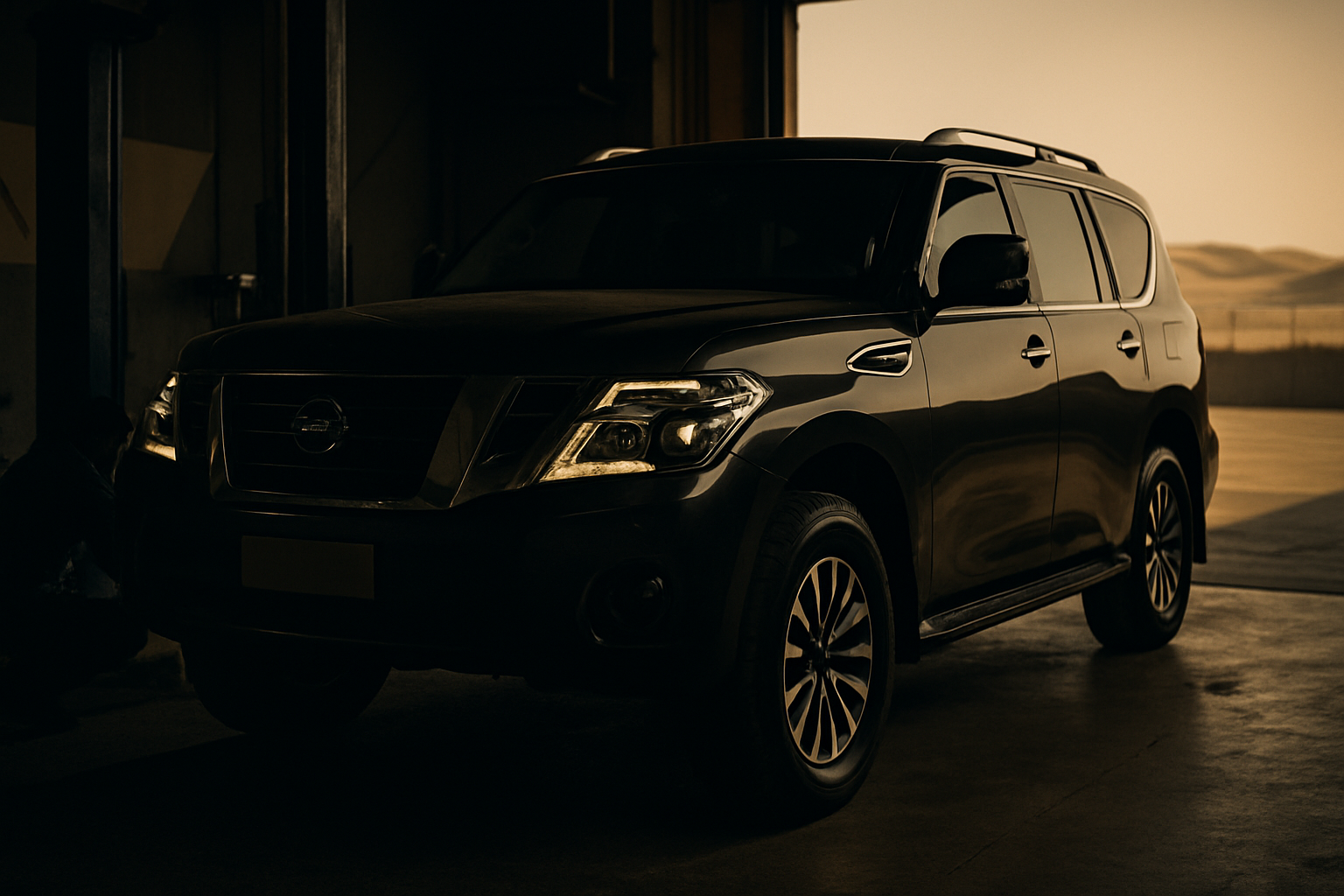
Quick answer: Nissan Patrol oil leaks most commonly come from the valve cover gasket, rear main seal, oil pan gasket, or front crankshaft seal. In the UAE, extreme heat (ambient temperatures reaching 45-50°C in summer) accelerates rubber seal degradation, making leaks more frequent than in cooler climates. Any visible oil drip or persistent low-oil warning should be diagnosed promptly, as running a VK56VD V8 or ZD30 diesel low on oil can cause serious engine damage.
Own one, or about to? Tell us the year and we will tell you what that particular car tends to need in Dubai heat.
Ask about your Patrol →An oil stain on the driveway is easy to ignore, especially when the Patrol seems to be running fine. That is usually a mistake, because nothing under a Patrol has ever fixed itself out of politeness. What starts as a small seep around a valve cover gasket can worsen quickly once the rubber has started to break down, and the UAE climate does not give seals a long retirement. Rubber compounds that might last 10 years in a temperate climate can fail in five or six here, partly because of the sustained heat and partly because of the stop-and-go driving on roads like Sheikh Zayed Road and Sheikh Mohammed Bin Zayed Road, which keeps engine temperatures elevated for longer periods. Add sand and dust ingress and the occasional dune run at Liwa or Big Red, and the conditions are genuinely tough on every seal and gasket on the engine. Per UAE consumer protection guidelines, vehicle owners have the right to a clear diagnosis and itemised repair estimate before any work begins, so understanding what you are likely looking at before you walk into a workshop is always worth the effort.
What are the most common Nissan Patrol oil leak locations?
The majority of Patrol oil leaks come from one of a handful of predictable locations, most of which are gasket or seal failures rather than cracked components.
- Valve cover gasket. This is the single most frequent source on both the Y61 and Y62. The VK56VD V8 in the Y62 has two valve covers, one per cylinder bank, and the rear sections of these gaskets are notoriously prone to seeping. Oil tracking down the back of the engine can be mistaken for a rear main seal leak, so it is worth cleaning the engine and identifying the origin point before assuming the worst.
- Rear main seal. This seal sits between the engine block and the gearbox. A genuine rear main seal failure is more serious to repair because the gearbox or transmission must come out to access it. On the Y62, that means pulling the seven-speed Jatco JR710E, which is a significant job.
- Oil pan gasket. The pan sits low on the engine and takes the full heat from the road surface. Dubai tarmac can exceed 70°C in summer, and that heat cycles into the pan constantly.
- Front crankshaft seal. This seal can wear a groove into the crankshaft pulley over time. If the sealing surface is scored, replacing just the seal may not stop the leak and the pulley itself may need attention.
- Camshaft seals. Less common but worth checking if the front of the engine is oily and the crankshaft seal looks intact.
- Oil filter housing and oil cooler lines. The O-ring on the oil filter cap is a simple fix but gets overlooked. Older Y61s with oil cooler lines can develop corrosion-related leaks at the fittings, particularly on vehicles used near the coast where salt humidity is a factor.
- Turbo oil feed and return lines on diesel Y61s. The ZD30 engine has known issues with the injector tube seals and the valve cover gasket, and the intercooler on the ZD30di can obscure the injector tube area, making diagnosis harder without partial disassembly.
How do I know my Patrol is leaking oil rather than burning it?
Oil that disappears without leaving a puddle is being burned or entering the coolant, not leaking externally.
A drip or stain on the floor is the obvious sign of an external leak. Other indicators are a burning smell from the engine bay (oil hitting the exhaust or hot engine components), blue-grey smoke from the exhaust on startup or under acceleration, and a dipstick reading that drops noticeably between services. If the oil level is dropping but there is no stain under the car and no smell, the engine may be burning oil past worn piston rings or valve stem seals, or a head gasket may be allowing oil into the coolant circuit. These are different problems with different repair paths.
Drivers who cover long highway distances between Sharjah and Dubai, which at 6pm counts as an endurance event for both of you, or who do regular desert runs should check the dipstick more often than the service interval suggests. The VK56VD is a large-displacement V8 and it holds a substantial oil volume, but that also means a slow leak can go unnoticed for weeks before the level becomes dangerous.
Why does Dubai's climate make Patrol oil leaks more common?
Heat is the primary accelerant of seal and gasket failure, and the UAE sits at the harsher end of the scale globally.
Rubber seals expand when hot and contract when cool. In Dubai, that cycle is severe: engine bay temperatures during a summer afternoon run can be significantly higher than the ambient 45-50°C air temperature, and then the vehicle sits overnight and cools completely. That thermal cycling fatigues the rubber over time, causing it to harden, crack, and eventually seep. Silicone-based gaskets handle this better than older cork or fibre materials, which is why older Y61s (some of which are approaching 20 years of use in the UAE) are particularly prone to multiple simultaneous leaks. The Y62, launched in the UAE in 2010, uses more modern materials, but high-mileage Y62s are now old enough to show gasket wear, especially around the valve covers.
Sand ingress is a secondary factor, and anyone who has tried to vacuum a Patrol after a morning at Big Red knows sand does not leave voluntarily. Fine particles can abrade sealing surfaces over time, particularly on vehicles that do regular off-road driving. A seal that might last another two or three years on a highway-only vehicle can fail sooner if grit is working against it.
What happens if a Patrol oil leak is left untreated?
A slow seep becomes a fast leak eventually, and the consequences of running the engine low on oil are severe.
Engine oil does three jobs: it lubricates, it cools, and it helps clean. When the level drops, all three are compromised. The VK56VD V8 runs at high oil pressure and uses oil volume to manage heat. If oil pressure drops due to low level, the engine can suffer bearing damage, cam follower wear, and in worst cases, catastrophic internal failure. An engine rebuild or partial overhaul on a V8 Patrol is a major job whose cost depends on what needs replacing. A valve cover gasket replacement costs far less.
There is also a fire risk. Oil dripping onto the exhaust manifold or turbo housing can ignite. Per Dubai Police road safety guidance, a vehicle fire on a highway must be reported and vehicles with known mechanical hazards should not be driven until the fault is rectified.
How is a Patrol oil leak diagnosed properly?
A proper diagnosis starts with a clean engine, not with guessing based on where the oil appears on the outside.
Mechanics typically degrease the engine bay, then road-test or run the engine to operating temperature, then inspect carefully with a torch and sometimes UV dye. UV dye is added to the oil and glows under a UV light, making the exact leak point much easier to find even when oil has tracked far from the source. This matters particularly on Y62 engines where the rear of the valve cover gasket can allow oil to travel down the back of the block and appear near the gearbox bellhousing, mimicking a rear main seal leak. Diagnosing without cleaning first wastes time and can lead to the wrong part being replaced.
At Patrol Garage, we see misdiagnosed leaks regularly, usually from vehicles where the engine was inspected dirty, which is a bit like searching for a leak with the lights off. Getting the source right before any parts are ordered is worth the extra time.
What does it cost to fix a Patrol oil leak in the UAE?
Repair cost depends heavily on which seal or gasket has failed and how accessible it is.
Valve cover gaskets are labour-intensive on the VK56VD because both covers have to be accessed carefully on a V8 layout, but the parts themselves are not expensive. Oil pan gaskets require the pan to be dropped, which is straightforward. A rear main seal is a significantly bigger job because the transmission must be removed first, and on the Y62, that means handling the Jatco JR710E seven-speed unit. Front crankshaft seal jobs add complexity if the sealing surface on the pulley is worn and needs sleeving or replacement.
We quote per job at Patrol Garage rather than publishing fixed prices, because the actual cost depends on the specific leak location, the condition of surrounding components once disassembly begins, and which parts are required. The workshop labour rate ranges above are general UAE market context.
Y62 vs Y61: does the oil leak profile differ?
Yes. The engine type, age, and design mean the two generations have different common failure points.
The Y61 (still sold as the Super Safari in the GCC today) is most commonly found in the UAE with either the TB48 petrol V8 or the ZD30 diesel. ZD30 leaks are a known subject: injector tube seals, valve cover gaskets, and rear main seals are all regular occurrences. The intercooler on the ZD30di blocks a direct view of the injector tube area, so diagnosis requires partial disassembly. The valve cover gasket on the ZD30 commonly leaks from the rear, tracking oil down the bellhousing in a way that looks exactly like a rear main seal leak to someone who has not cleaned and traced the source.
The Y62 with the VK56VD 5.6L V8 has a different leak pattern. Valve cover gaskets on both banks are the most frequent complaint. Oil cooler connections and the oil filter housing O-ring are also seen. Y62 rear main seal failure is less common than on older Y61 diesels but is not rare on high-mileage examples.
The Y63 is too new for a meaningful leak history to have developed. Owner information on that model is limited to what the manufacturer publishes.
Frequently Asked Questions
Why is my Nissan Patrol leaking oil from the back of the engine?
Oil at the rear of the engine most often comes from either the rear section of a valve cover gasket or the rear main seal. On the Y62 VK56VD, the rear of the left-hand valve cover gasket is a particularly common seep point, and the oil travels down the back of the block before it becomes visible. A rear main seal leak is possible but involves removing the transmission to confirm and repair. Cleaning the engine first and running it to temperature before inspecting is the only reliable way to identify the actual source.
Is it safe to drive a Nissan Patrol with an oil leak?
A very slow seep where the oil level remains stable between checks is lower risk than a fast drip, but neither should be ignored. If the oil level is dropping by more than 0.5 litres between services, or if there is a visible puddle under the car after parking overnight, the vehicle should be inspected before further long drives. Running a VK56VD V8 low on oil can cause bearing and cam follower damage, and oil on a hot exhaust or turbo housing is a fire risk. The UAE summer heat makes a small leak worse faster than owners often expect.
How often should a Nissan Patrol be checked for oil leaks in the UAE?
Checking the dipstick every two to three weeks is reasonable for a Y62 used in regular Dubai traffic. Visually checking under the car after an overnight park costs nothing and catches early leaks before they become expensive. At every periodic service, the underside and engine bay should be inspected for fresh oil traces. Owners who do regular off-road driving at places like Big Red or Liwa should add a check before and after each outing, as rough terrain and heat cycling both stress seals.
Can I use a stop-leak additive to fix a Nissan Patrol oil leak?
Stop-leak additives swell rubber seals temporarily and can reduce a seep in the short term, but they do not fix a failed gasket. On a VK56VD V8 with a genuine gasket failure, an additive is not a repair and should not be used as a substitute for diagnosis. Some additives can affect oil viscosity or interfere with oil pressure readings. The correct approach is to find the source, replace the seal or gasket, and use the right grade of oil for the UAE climate on refill.
When to bring it to Patrol Garage
If you are seeing oil stains under your Y62, noticing a drop in oil level between services, or getting a burning smell from the engine bay, the right step is a proper diagnosis before the leak gets worse. We work exclusively on Nissan Patrols, which means we see these failure patterns regularly and carry the relevant parts. Bring the vehicle in and we will clean, inspect, and identify the exact source before quoting any repair work. Here is what we do to a Y62, job by job.
Last updated: September 2026