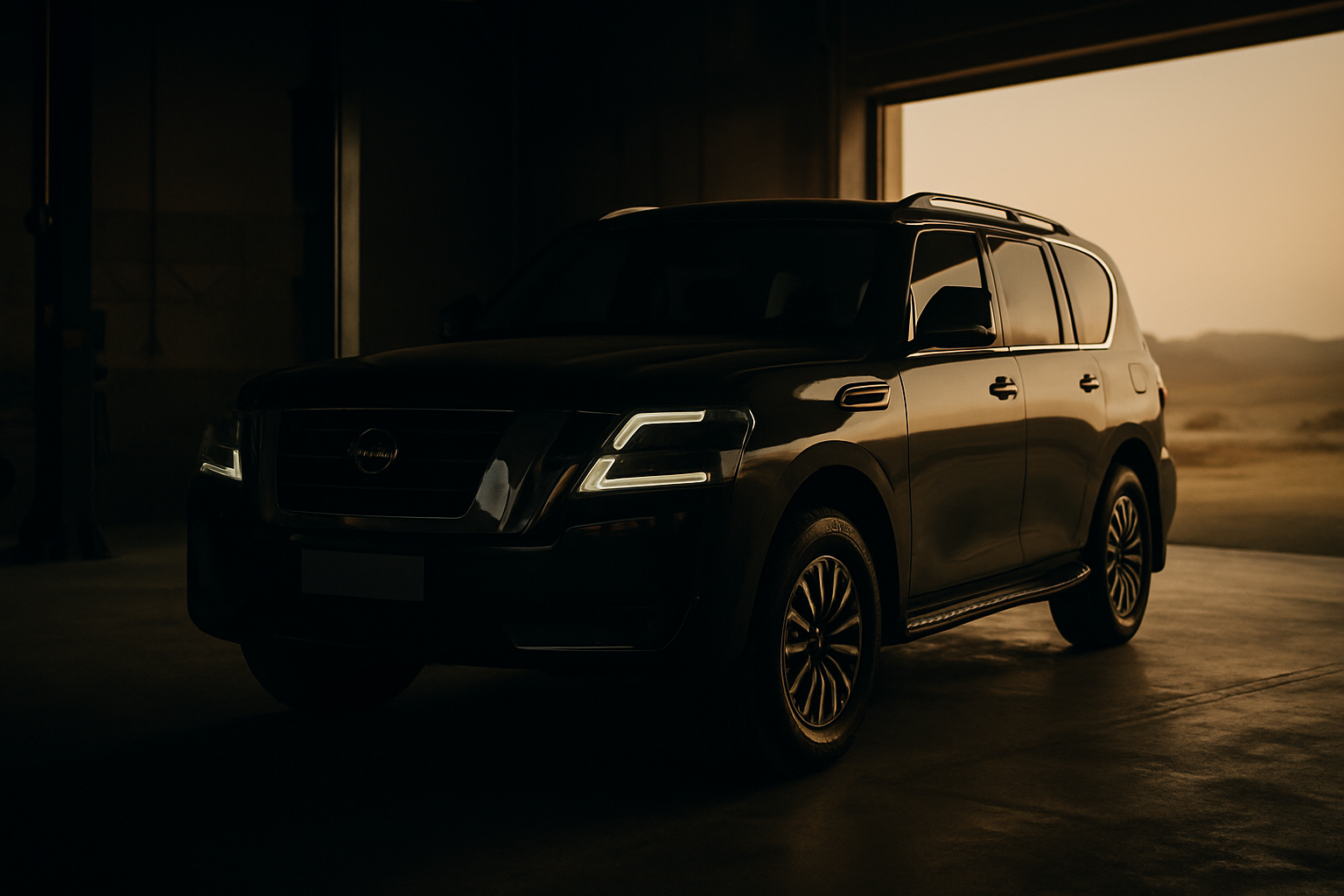
Quick answer: Nissan Patrol vibration when driving is most commonly caused by unbalanced or damaged tyres, worn suspension components (tie rod ends, ball joints, bushings), warped brake rotors, or failing wheel bearings. Dubai conditions accelerate this wear: 70°C+ tarmac degrades rubber faster, desert driving knocks balancing weights off rims, and repeated speed bumps on Sheikh Zayed Road stress suspension joints. Diagnosis starts by noting exactly when the vibration occurs, at speed, under braking, or at idle, since each pattern points to a different system.
Own one, or about to? Tell us the year and we will tell you what that particular car tends to need in Dubai heat.
Ask about your Patrol →A Nissan Patrol that vibrates is telling you something specific. The problem is that "vibration" covers a wide range of symptoms, and the wrong diagnosis means replacing parts that were never the issue. Watch for this trap: paying for a wheel balance and new tyres but still feeling the shake because the real cause was a worn tie rod end or a warped front rotor. Dubai makes diagnosis slightly harder because several problems can develop at the same time. They rarely take turns. The combination of 45 to 50°C summer heat, abrasive sand from routes like Al Qudra and Big Red, and heavy stop-and-go on Sheikh Mohammed Bin Zayed Road puts suspension and drivetrain components under stress that owners in cooler climates rarely see. If you run large-diameter aftermarket wheels, you have a vehicle that is more sensitive to imbalance and alignment issues than the factory setup. The Y62 in particular, with its independent double-wishbone front suspension and the hydraulic body motion control (HBMC) system, has components that are expensive to replace and worth diagnosing accurately the first time. The guide below works through the causes by symptom pattern, which is the fastest route to the right fix.
What does it mean when vibration only happens at highway speeds?
Speed-dependent vibration that appears between roughly 100 and 140 km/h and either holds steady or gets worse is almost always a rotating-assembly problem, not a suspension or engine problem.
The most common cause is wheel and tyre imbalance. After off-road use, mud and sand stick to the inside of rims and shift the weight distribution. Big Red does not charge an entry fee, it just sends a few kilos of itself home inside your rims. Balancing weights detach on washboard desert tracks. Even a small mass difference, amplified by centrifugal force at highway speed, produces the rhythmic steering wheel shake that Y62 owners often notice between 110 and 130 km/h on the Abu Dhabi highway. A basic balance and check costs very little and should always be the first step.
Bent or deformed rims are the next thing to rule out. The aluminum wheels on the Y62 are lighter than the steel units on the Y61, but they dent more easily on desert tracks and against concrete curbs. A rim that looks straight to the eye can still have enough lateral runout to cause a consistent pulse at speed. A workshop with a road-force balancing machine will catch this where a standard spin balance will not.
If the balance and rims check out, look at the driveshaft. A worn or dry propeller shaft universal joint produces a vibration that tracks with vehicle speed and often has a faint hum underneath it. On Y62 models with high mileage or those that have spent time in salt-humid coastal areas around Dubai Marina and Jumeirah, the grease nipples on the shaft joints dry out faster than expected.
What causes vibration only when braking?
Vibration that appears specifically when pressing the brake pedal, especially between 80 and 50 km/h, points to the braking system rather than tyres or suspension.
Warped front brake rotors are the most frequent cause. Patrol rotors warp when they overheat and then cool unevenly. This happens on long descents, after towing, or simply from repeated heavy braking in stop-and-go traffic. The 70°C+ tarmac temperature in a Dubai summer adds heat from below while the brakes add heat from above. You feel the result as a pulsing through the brake pedal and steering wheel that gets worse the harder you brake.
A stuck or seized brake caliper causes a different pattern: the vehicle vibrates and pulls to one side, and you may smell hot metal after a drive. Calipers seize when the slider pins corrode, something that happens faster in coastal areas of the UAE where salt humidity is higher. Per the RTA, vehicles in Dubai are required to pass an annual roadworthiness inspection that includes a brake performance test, and a seized caliper will fail that check. Getting it sorted before the inspection is the practical reason to address this early, but the safety reason matters more.
Less commonly, air or contaminated fluid in the brake system causes a spongy, inconsistent pedal with occasional vibration under heavy braking. Brake fluid absorbs moisture over time, and in Dubai's humidity, the interval between fluid changes matters.
Why does the Patrol shake at idle or when stopped in gear?
If the vibration is present at a standstill with the engine running, particularly in drive with your foot on the brake, the wheels and tyres are not involved. The source is almost always the engine or its mounting.
Engine misfires are the leading cause. A misfire on the Y62's VK56VD 5.6L V8 can be caused by a fouled spark plug, a failing ignition coil, or a fuel injector that is not delivering the correct spray pattern. The V8 has eight cylinders to check, and in a hot climate, coil packs degrade faster. You will often see fault codes P0300 (random misfire) or P030X (cylinder-specific) stored in the ECU. If the check engine light is on, reading those codes first saves time.
Worn or cracked engine mounts are the other common cause. The mounts isolate the engine from the chassis, and when the rubber inside them deteriorates, normal engine vibration transmits directly into the cabin. The engine stops keeping its opinions to itself. A quick check is to put the vehicle in drive with the handbrake on and watch the engine under the bonnet: excessive movement when you blip the throttle suggests the mounts are soft or broken.
Vacuum leaks and fuel delivery issues (low fuel pressure, weak pump, dirty injectors) can also cause rough idle and shaking, particularly on higher-mileage Y61 and Y62 units.
What suspension components cause vibration on the Y62?
Worn suspension parts cause vibration that is typically felt through the steering wheel while driving over rough surfaces, or as a general looseness in the front end on normal roads.
Tie rod ends and ball joints are the most common wear items. They have a defined service life that shortens considerably with off-road use. Dune day is recreation for you and overtime for them. A failing outer tie rod end produces a vibration that worsens when the steering is loaded, for example when changing lanes at speed or cornering. Inner ball joints on the Y62's double-wishbone arms develop play that can be felt as a vague, wandering sensation at highway speeds.
Control arm bushings are a known wear point on both Y61 and Y62 generations. Rubber bushings crack and soften in extreme heat, and the Y62 sees enough temperature cycling between air-conditioned parking and 50°C exterior conditions that bush life is shorter than in temperate markets. Deteriorated bushings allow the control arm to move in directions it should not, which the driver feels as shimmy or imprecise steering response.
The Y62 also has the HBMC (hydraulic body motion control) system, which uses hydraulic shock absorbers rather than conventional dampers. When an HBMC accumulator or shock loses pressure, it produces a distinct wallowing feeling and vibration over mid-corner bumps. Replacement parts for this system are expensive, and a full four-corner job is a significant repair. It is worth confirming the diagnosis before committing to that spend.
How do wheel bearings cause Patrol vibration?
A worn wheel bearing produces a vibration and a grinding or humming noise that changes pitch as vehicle speed changes, and it is one of the easier patterns to identify once you know what to listen for.
The clearest sign is that the hum changes when you gently swerve left and right at highway speed. If the noise gets louder on a right swerve, the left front bearing is usually the problem (and vice versa), because the weight transfer loads the bearing differently. On the Y62 with its heavier kerb weight (over 2,700 kg), bearings work harder than on lighter SUVs, and wear accelerates after significant off-road use where lateral loads are higher.
Ignoring a failing bearing is not a safe choice. A bearing that fails completely can cause a wheel to seize or, in a worst case, separate from the hub. Dubai Police traffic reports consistently list mechanical failure as a contributing factor in highway incidents, and a failed bearing qualifies. If the hum is there, get it checked before a long trip to Abu Dhabi or Liwa.
Does tyre condition and pressure matter that much in the UAE?
Yes, more than in most markets. Tyre pressure changes with temperature: a tyre inflated to spec at 25°C in an air-conditioned workshop will be overinflated once the vehicle has been parked on 70°C tarmac for an hour. Overinflated tyres transmit more road imperfections into the chassis and make the vehicle feel agitated on the highway. Underinflated tyres flex excessively and cause low-speed vibration and pull.
Check tyre pressure when the tyres are cold, meaning before driving, using the figure on the door jamb sticker rather than the maximum pressure printed on the tyre sidewall. On Y62 models, the recommended pressures differ between on-road and off-road use, so remember to reinflate after a desert run. A tyre that was aired down to 18 psi for soft sand and driven back to Dubai without being reinflated will vibrate and wear unevenly.
Flat spots develop on tyres left stationary for several weeks, which is relevant for owners who leave their Patrols during extended travel. The flat spot usually works itself out after a few kilometres, but if it does not, the tyre needs professional assessment.
Why does my Nissan Patrol vibrate between 100 and 120 km/h but feel fine otherwise?
This is the classic signature of wheel and tyre imbalance. At those speeds, even a small weight discrepancy on a rim creates enough centrifugal force to produce a rhythmic shake through the steering wheel. Off-road use, particularly on desert tracks where the Y62 is commonly driven in the UAE, knocks balancing weights off rims and packs mud into the inner rim. Start with a full four-wheel balance and check all rims for visible or measured runout. If the vibration persists after balancing, have the driveshaft universal joints inspected.
My Patrol shakes when I brake but not the rest of the time. What is causing it?
Braking-specific vibration felt through the steering wheel and pedal is almost always warped front brake rotors. Rotors warp when they overheat and cool unevenly, which happens faster in Dubai's heat, especially after towing or repeated hard braking in traffic. The fix is machining the rotors if they have enough material left, or replacing them. A seized brake caliper causes a similar symptom but also produces pulling to one side and a burning smell after driving.
How much does it cost to fix Patrol vibration in Dubai?
The cost depends entirely on the cause. A wheel balance is inexpensive and is the right starting point. Brake rotor replacement for a Y62 is a mid-range job using market-rate parts and labour. Suspension work varies significantly: worn tie rod ends or bushings are more affordable, while a full HBMC shock absorber replacement on the Y62 is expensive in parts alone. Engine-related vibration (misfires, spark plugs, coil packs) also varies by how many components need replacing. Any workshop, including Patrol Garage, will quote per job after diagnosis rather than giving a flat rate before the vehicle is inspected.
Can I drive my Patrol if it is vibrating, or do I need to stop immediately?
It depends on the severity and the pattern. A mild vibration at highway speed from tyre imbalance is not immediately dangerous but will wear tyres and steering components unevenly if left for months. A vibration that appears suddenly and is severe, or that comes with pulling to one side and noise, should not be ignored: those patterns suggest a failing wheel bearing, a broken suspension component, or a seized caliper, all of which can become a safety issue. If you are unsure which pattern applies, have the vehicle checked before a long drive.
When to bring it to Patrol Garage
If the vibration is new, getting worse, or accompanied by noise, pulling, or a dashboard warning light, bring the Y62 in for a diagnostic check. We handle the full range of causes described above: wheel and tyre assessment, brake inspection and rotor work, suspension component diagnosis and replacement (including HBMC on the Y62), wheel bearing replacement, engine misfire diagnosis on the VK56VD, and driveshaft inspection. We work on Y62 Patrols and are straightforward about what we find before any work begins. The rest of the work handled at Patrol Garage is listed here.
Last updated: October 2026